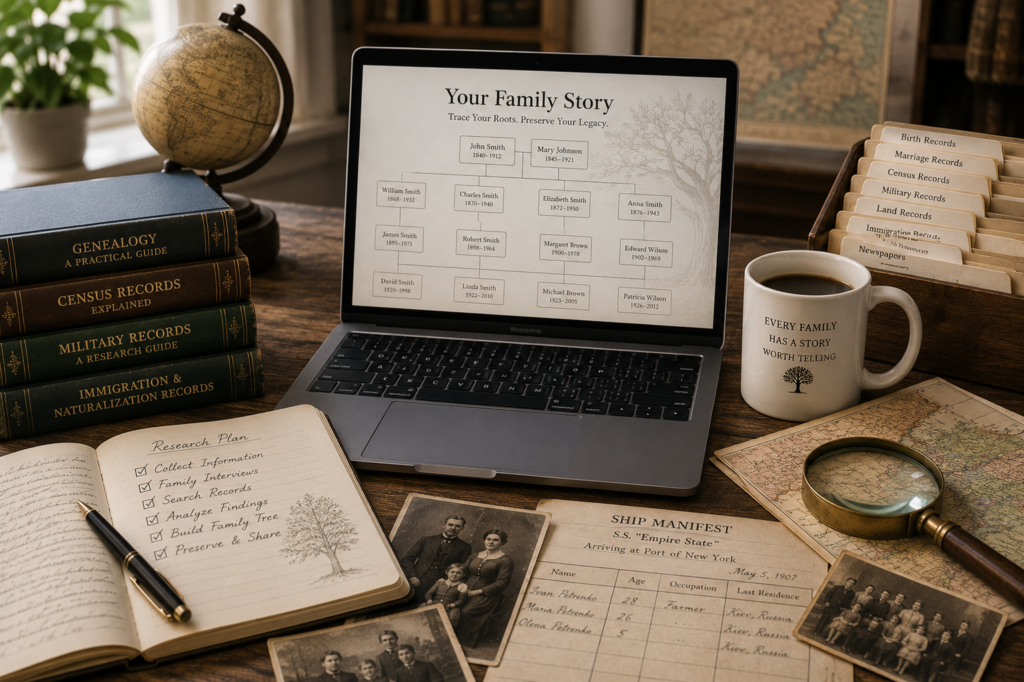
For the majority of families that lived in the territory of modern-day Ukraine prior to the early 20th century, parish registers (metric books) and confessional lists remain the primary, and often the only, source of information regarding birth, marriage, death, and family composition. Working with these documents requires an understanding of how they are structured, where they are stored, and what limitations they have — without this knowledge, the search can easily turn into wandering blindly.
What Are Parish Registers (Metric Books)
A parish register (metric book) is an official register of vital statistics maintained by a religious community: an Orthodox parish, a Greek Catholic parish, a Roman Catholic church, a synagogue, or a mosque. Before the introduction of civil registration of vital statistics, it was the church that recorded three key events in a person’s life:
- Birth and baptism — indicating the date of birth, date of baptism, the child’s name, the names and social class (estate) of the parents, as well as godparents (sponsors);
- Marriage — detailing the names of the groom and bride, their ages, marital status at the time of the wedding, and the names of parents and witnesses (bondsmen);
- Death — indicating the date, cause of death (often in a generalized form), and the age of the deceased.
Parish registers were usually maintained in three copies: one remained in the parish, another was transferred to the consistory (the church administration of the diocese), and a third was sometimes sent to state authorities. This is important: if a copy in one repository has been lost, there is still a chance that a duplicate has been preserved in another archive.
What Are Confessional Lists
Confessional lists (confessional rolls or confessional registers) were annual lists of parishioners compiled by Orthodox parishes to keep track of those who attended confession and communion. Unlike parish registers, which record individual events, a confessional list provides a snapshot of a family in a specific year: it lists all members of the household, indicating their ages and family relationships — head of the household, wife, children, and sometimes parents or other relatives living together.
This makes confessional lists an indispensable source in two situations:
- When parish registers for the required period have not survived, but the confessional list for that same year has;
- When you need to establish the complete composition of a family at a single point in time, rather than gathering it from separate birth and marriage records over many years.
The drawback of confessional lists is their lesser degree of detail: exact dates of events are not listed, only the age at the time the document was drawn up, which requires subsequent verification through other sources.
Where to Look: The Logic of Fund Distribution
Parish registers and confessional lists in Ukraine are stored primarily in state regional archives — according to the location of the parish at the time the document was created, rather than modern administrative divisions. Substantial collections are also concentrated in:
- The Central State Historical Archives of Ukraine in Kyiv (CDIAK) — documents for Right-Bank Ukraine and parts of Left-Bank Ukraine that were part of the Russian Empire;
- The Central State Historical Archives of Ukraine in Lviv (CDIAL) — documents for Western Ukrainian lands that were part of the Austro-Hungarian Empire, and subsequently Poland;
- Diocesan and church archives — copies not transferred to state repositories may still be preserved there;
- Foreign archives — if the territory belonged to another state during the period in question (Poland, Austria, Romania, Czechoslovakia).
Before sending a request, it is essential to determine which county (uyezd), province (guberniya), or crown land the settlement belonged to during the relevant period — administrative borders changed multiple times, and a parish could “move” from one archival collection to another.
How to Determine the Relevant Parish
A single settlement could belong to a parish in a neighboring village — peasants did not necessarily get baptized and married right where they lived. To determine the parish:
- Clarify the family’s denomination — Orthodox, Greek Catholic, Roman Catholic, Jewish.
- Locate the nearest church or synagogue of the corresponding denomination on historical maps or in directories of administrative and ecclesiastical divisions of that era.
- Keep in mind that large villages might have had their own parish, while smaller ones shared a parish with several neighboring settlements.
- If the initial request to the “obvious” parish yields no results, check neighboring parishes within the same county.
Nuances of Working with the Documents
Even after obtaining access to the relevant parish registers or confessional lists, several practical aspects should be considered:
- Language and Handwriting. Documents from the Russian Empire were maintained in Church Slavonic or Pre-reform Russian orthography; documents from Austria-Hungary and Poland were in Latin, Polish, German, or Ukrainian depending on the period and denomination. The scribes’ handwriting is often harder to decipher than the language itself.
- Calendar. Prior to 1918, the Russian Empire used the Julian calendar, which differs from the Gregorian calendar by 12–13 days — this must be taken into account when cross-referencing dates from different sources.
- Incompleteness of Collections. By no means have all parish registers survived to the present day: some were destroyed during wartime, others in fires or during the Soviet era. A gap of several years in a set of documents for a single parish is a common occurrence, not a reason to consider the search hopeless.
- Repetitive Names. In rural parishes, the same names and surnames were repeated from generation to generation, so it is crucial to rely not only on the name, but also on age, social class, and parents’ names — otherwise, it is easy to confuse people with the same name.
How to Formulate an Archival Request
When contacting an archive regarding parish registers or confessional lists, you should immediately specify:
- The religious denomination and assumed parish;
- The full name (including patronymic, if known) of the person sought;
- The approximate year of the event (birth, marriage, death) or the year for which the confessional list is needed;
- The name of the settlement and county/province at the time of the event.
The more precisely formulated the request, the higher the likelihood that an archivist will be able to find the necessary file without a lengthy manual review of multiple collections — meaning faster and often less expensive processing.
What to Do If Documents Are Not Found
If nothing is found for the specified parish, the search should not be considered over. Possible reasons and next steps include:
- Check neighboring parishes in the same county — the family might have married or baptized children outside their place of official residence;
- Clarify whether the settlement belonged to a different administrative unit during another period and, accordingly, a different archival collection;
- Consider the possibility that the necessary copy of the document has been preserved in a church or foreign archive rather than a state one;
- Turn to confessional lists as an alternative if parish registers for the required year are completely lost.
Conclusion
Parish registers and confessional lists are the foundation of any genealogical research in Ukraine covering the period up to the early 20th century. Working with them requires not only patience, but also an understanding of ecclesiastical-administrative geography, the specifics of record-keeping by different denominations, and the details of archival storage. A correctly identified parish and a precisely formulated request save months of searching and help avoid unnecessary paid inquiries to archives where the required documents are known to be absent.
If you are unsure which parish your ancestors’ settlement belonged to, cannot decipher the handwriting or language of a found document, or want to build a precise plan for archival requests — book a consultation. We will help you determine the necessary funds, correctly state your inquiries, and make sense of the discovered metric entries.