Proof of Nationality
A Deep and Reliable Reconstruction of Your Family History — From the First Known Ancestor to the Farthest Branches
When a Single Document Is No Longer Enough
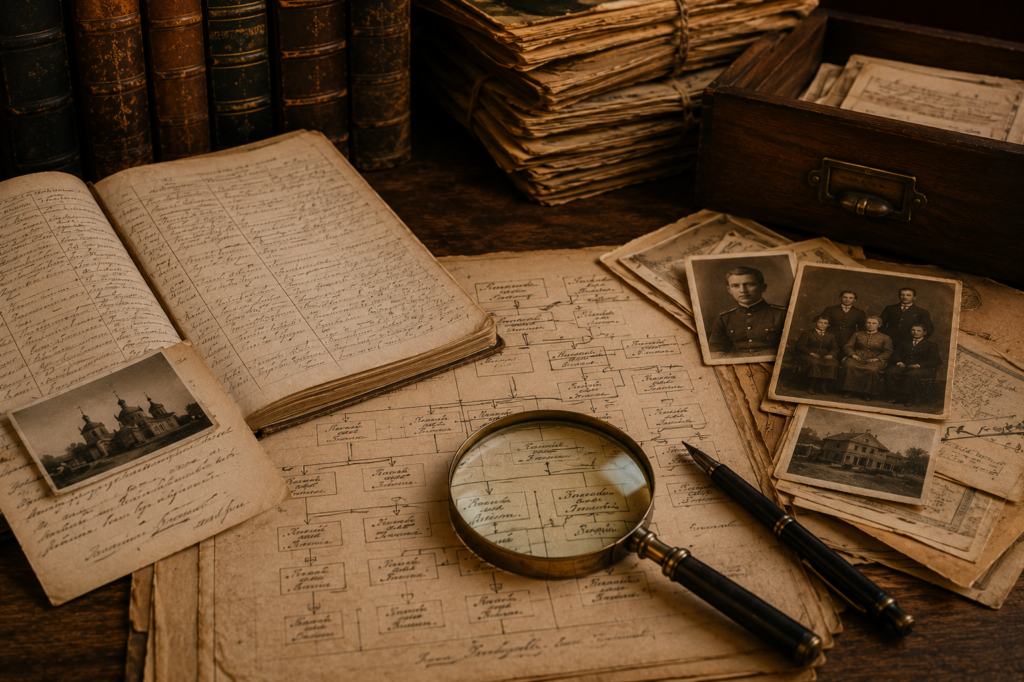
If your goal isn’t a single find but a complete, reliable reconstruction of your family’s history, a comprehensive approach is essential. This is systematic work in which different types of sources are cross-checked against one another, contradictions are identified and resolved, and every family connection is confirmed with documents — not assumptions or family legend.
I bring together every strand of archival work — from pre-revolutionary parish registers to Soviet-era personnel files, from military records to resettlement documents — into a single, consistent, and documented history of your family. This isn’t a mechanical sum of separate searches, but a unified investigation, where every find is fitted into the broader context and works toward the final picture.
Send a request — tell me what’s already known about your family, and I’ll propose a research strategy along with a preliminary cost estimate.
Where the Results Begin
These are the most common entry points that usually lead to a confident, document-supported result. Most comprehensive research projects draw on several of them at once — and it’s precisely that combination that produces results a single type of source could never achieve on its own.
This matters most in cases involving:
- Migration and resettlement. When a family changed its place of residence, and sometimes its country, over several generations, its traces end up scattered across archives in different regions and even different states — and without a systematic approach, part of the story is simply lost at the seams between archival systems.
- Surname changes. Due to shifting state borders, marriage, administrative reforms, and sometimes a deliberate change of surname for personal reasons — a person’s trail can split in two across the sources, and without cross-referencing the documents, those two lines will never converge back into one.
- Gaps in dates. When some events — a birth, marriage, or death — were never directly documented and have to be reconstructed from indirect evidence: an age listed in another document, a mention in a census, or the records of related family members.
- Missing family papers. When the oral history exists but no documentary trace has survived at all, and it has to be rebuilt from scratch — starting from the most general information (an approximate period, region, or religious affiliation) and gradually narrowing the search down to a specific archival file.
It’s precisely in these situations that a fragmented, one-off search stalls: it turns up isolated fragments but can’t assemble them into a single, logically consistent story. Comprehensive research solves that problem systematically.
How the Work Is Structured
We discuss what’s already known about the family: names, approximate dates, places, family stories, and any surviving documents or photographs. We define the goal of the research — personal interest, a family book, preparation for an official procedure — and the depth of reconstruction needed: how many generations, which lines take priority.
I review all the materials you already have and put together a plan of action: which sources to start with, which archives and fonds to prioritize, and what alternative paths to keep in reserve in case the primary source turns out to be lost.
I work across all relevant areas at once — from church records to Soviet-era personnel archives and military documents — progressively expanding the picture of the family. Throughout this stage, there’s continuous cross-checking: every new fact is tested for consistency against what’s already been established.
I identify and resolve discrepancies between sources: differing dates across documents, variant spellings of names, disputed family connections. Where a contradiction genuinely cannot be resolved directly, I state that plainly in the final report — rather than smoothing over the uncertainty or presenting a guess as a fact.
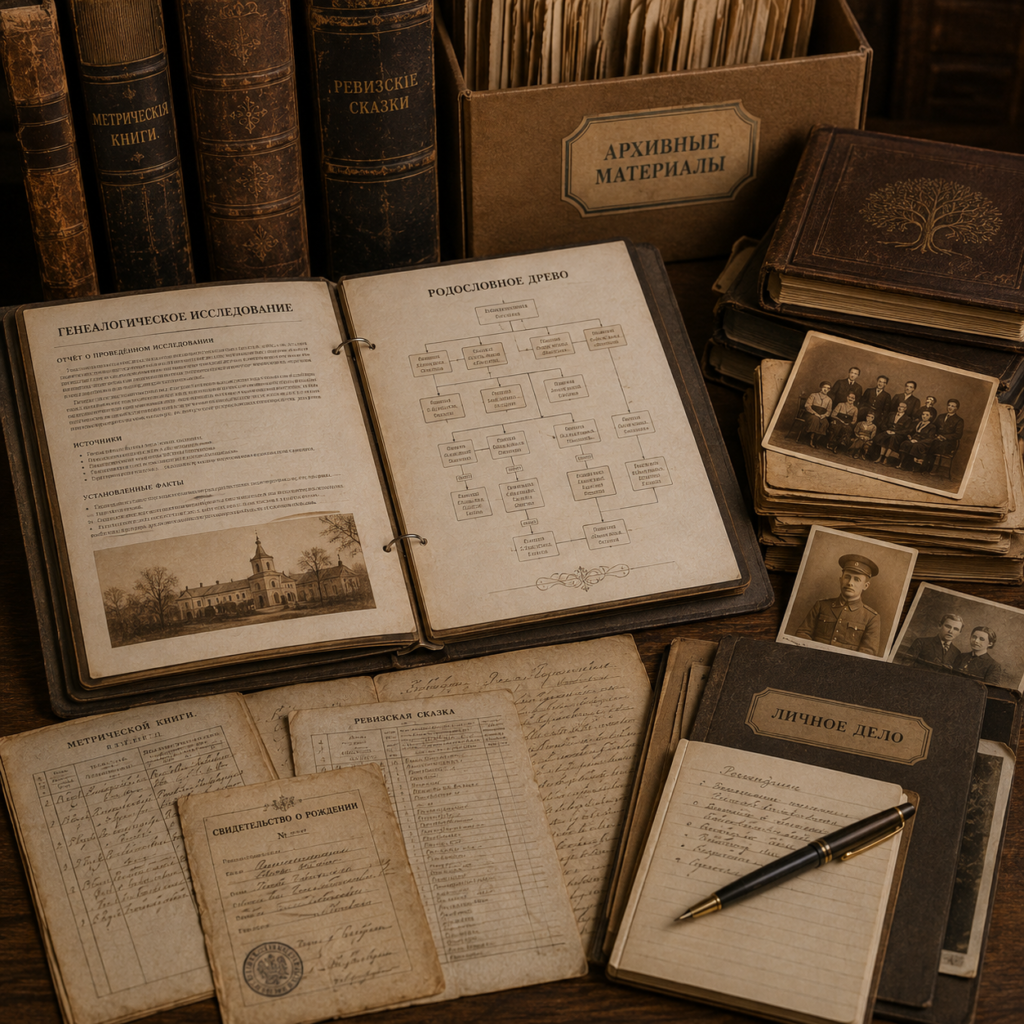
I bring the entire research together into a single structured document and hand it over along with specific recommendations for next steps — in case some lines remain open and you’d like to continue.
– Recommendations for Continuing the Research
If some lines remain unexplored, or there are promising directions for further search, you receive specific, practical recommendations on where to go next.
– Optionally, a Family Book or an Archival Dossier
The final result can be prepared not just as a working report, but as a full family book — a narrative, beautifully formatted document for your family archive that can be passed down through generations — or as a structured archival dossier, prepared for official use, for an attorney, or for submission to an authority.
Who This Service Is For
- Those who want a deep, reliable reconstruction of their family history — not for the sake of a single document, but for a complete understanding of their family
- Those whose family history involves migration, surname changes, lost documents, or significant gaps in dates
- Those who want a family book or archival dossier as a finished product in its own right
- Those who have already tried researching their family tree on their own but ran into contradictory or scattered data that needs to be brought together
- Those who want to leave their children and grandchildren not just a list of names and dates, but a coherent, documented story of their family