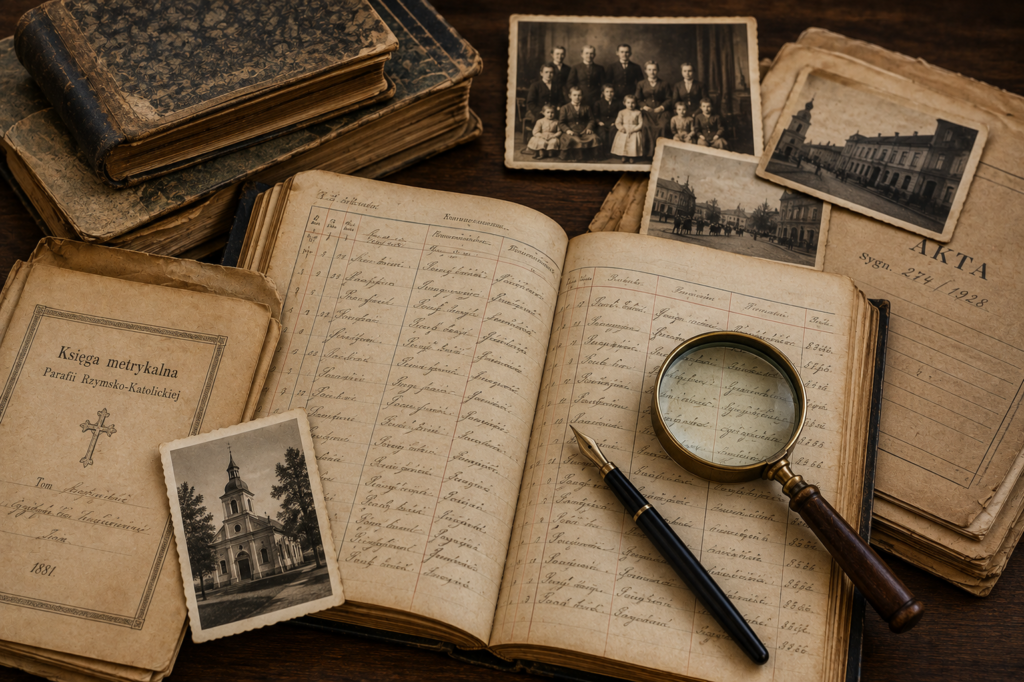
The Karta Polaka is one of the most common reasons people from Ukraine turn to genealogical research. Formally, the law does not require “proof” of Polish origin in the strict legal sense — the decision is made by a consul or voivode based on an interview and the materials submitted. In practice, however, an archival certificate confirming the origin of a Polish relative is most often exactly what makes an application convincing and removes the commission’s doubts.
What the Law Actually Requires for the Karta Polaka
The Karta Polaka Act allows people to apply if they can confirm that at least one parent, grandparent, or two great-grandparents were of Polish nationality or held Polish citizenship, or can present a document confirming affiliation with the Polish nation (for example, participation in organizations linked to Polish culture, if direct kinship is harder to prove).
The key word here is “confirm.” The law does not formally list an exhaustive set of documents, but in practice consulates treat archival documents as the primary and most weighty form of evidence, because:
- a written statement and interview are, by themselves, subjective and easy to dispute;
- a parish register or census entry is an independent, dated source that cannot be produced after the fact;
- an archival document usually contains a direct statement of an ancestor’s religious affiliation, nationality, or native language — precisely what needs to be proven.
Which Documents Are Accepted as Proof of Polish Origin
1. Roman Catholic parish registers For relatives who lived on the territory of modern-day Ukraine before the early 20th century, a record of baptism, marriage, or burial in a Roman Catholic parish is one of the strongest documents available. In these lands, membership in the Roman Catholic Church correlated in the vast majority of cases with Polish (less often German or Czech) origin, and consulates are well aware of this.
2. Materials from the 1897 population census The only pre-revolutionary census that recorded native language — a direct indicator that a consulate can accept as evidence of a Polish-speaking family origin.
3. Documents from the interwar period (1918–1939) If ancestors lived during this time on territory that belonged to interwar Poland (a significant part of what is now Western Ukraine), the following are especially valuable:
- civil registry records from Polish registry offices;
- school records and educational institution registers;
- citizenship documents and interwar-era identity papers.
4. Soviet-era documents stating nationality Passports, birth certificates, questionnaires, and personal files from the Soviet period, in which the “nationality” field states “Pole” (male or female) — direct and fairly weighty evidence for later generations.
5. Documents related to repression and deportation A significant portion of the Polish population of Right-Bank and Western Ukraine was deported in the 1930s–1940s specifically on ethnic grounds. Case files from the archive of the Security Service of Ukraine and its regional departments in such cases not only confirm origin but also contain detailed family questionnaire data that is hard to find anywhere else.
Why an Independent Search Often Ends in Failure
In practice, applicants most often run into one of three problems:
- not knowing which archive to search in — Roman Catholic parish registers are often held separately from Orthodox ones, in different funds, and for western regions may be held in Polish archives altogether;
- being unable to read the document — 19th-century parish registers were kept in Polish or Latin, often in cursive script, and deciphering an entry without specialized training is extremely difficult;
- finding the document but being unable to have it properly issued — for a consulate, simply finding a record is not enough; the archival extract must be issued in the required form, bearing the archive’s seal, and if necessary translated and apostilled.
That is precisely why most successful Karta Polaka applications ultimately rely not on self-found copies, but on officially issued archival certificates.
What the Document Search Process for Karta Polaka Looks Like
The ancestor’s full name (in both Polish and Russian/Ukrainian spelling), approximate date and place of birth, and the parish the family may have belonged to.
Depending on the region and period — a regional state archive, the Central State Historical Archives of Ukraine in Lviv or Kyiv, or, if the territory belonged to interwar Poland or earlier Austro-Hungarian rule, the archives of Poland or Austria.
Checking the parish registers of the specific parish for the relevant period, and, if the exact date is unknown, adjacent years as well.
— a document in the established format that the archive issues based on the search results.
— a document in its original language usually needs to be accompanied by a translation for submission to the consulate.
What to Do If No Direct Documents About the Polish Ancestor Have Survived
This happens — some archives were damaged during wars, and some documents were destroyed during the Soviet period. In this case, it makes sense to:
- search for documents about older or younger relatives of the same parish — records of the baptism of an ancestor’s siblings, for example, may contain the same information about the family’s origin;
- check the parish’s confessional lists — even without a record of a specific event, the mere fact that the family belonged to the parish can serve as indirect confirmation;
- expand the search to related archival funds — court, notarial, and land-ownership documents, where religious affiliation or nationality was sometimes recorded.
The Bottom Line
The Karta Polaka does not require a single “perfect” document — the commission evaluates the body of materials submitted as a whole. But the more official, precise, and properly issued the archival confirmation is, the higher the chances of a positive decision on the first attempt. Given that part of the required funds may be held outside Ukraine, and that searching and reading old parish registers requires specialized skills, independent archival work on this topic often takes months and does not always produce results.
If you are planning to apply for the Karta Polaka and want to find out in advance which archival materials can realistically confirm your family’s origin — sign up for a consultation. We will help identify where to look for the necessary documents and prepare an archival certificate in the format a consulate will accept.