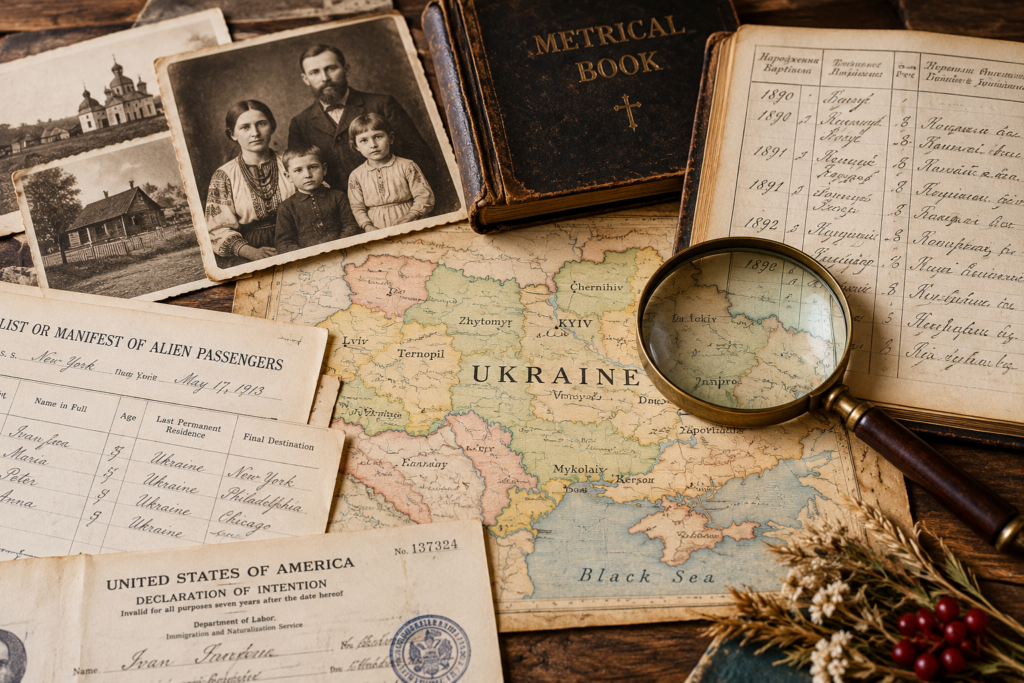
For many people with Ukrainian roots, family history begins with a simple question: Where exactly did my ancestors come from? You may know that your grandparents or great-grandparents were born in Ukraine, but the name of their village has been forgotten. Perhaps an old immigration document contains an unfamiliar place name, or a family story mentions a town that no longer appears on modern maps.
Finding your ancestors’ village is often the key to unlocking generations of family history. Once the original place of residence is identified, it becomes possible to search church registers, historical census records, and archival documents that may reveal the names and lives of earlier generations.
Why Finding the Ancestral Village Is So Important
Unlike modern databases, many historical Ukrainian records were organized geographically rather than by surname. Births, marriages, and deaths were often recorded in parish registers connected to particular churches and communities. Without knowing the family’s place of origin, searching for a common surname across Ukraine can be extremely difficult.
For example, families named Koval, Melnyk, or Shevchenko lived in many different regions. Finding someone with the correct surname does not necessarily mean that person belongs to your family. Identifying the village helps narrow the search and determine which archives may contain relevant historical records.
Start with Family Documents and Memories
Before contacting an archive, collect everything your family already knows.
Even small details can provide valuable clues:
- Old passports and immigration papers.
- Birth, marriage, and death certificates.
- Letters and postcards from relatives.
- Family photographs with handwritten notes.
- Religious documents and church certificates.
- Naturalization and citizenship records.
- Names of relatives who remained in Ukraine.
Ask older family members whether they remember village names, nearby towns, churches, or regional traditions.
Sometimes a family remembers only that its ancestors came from Galicia, Volhynia, Bukovina, or another historical region. Although this information may seem vague, it can significantly narrow the geographical search.
Check Immigration and Passenger Records
For descendants of Ukrainian immigrants, immigration documents are among the most useful starting points. Depending on the country and historical period, passenger lists, immigration files, and naturalization records may contain information about an ancestor’s birthplace or last residence. For families who emigrated to the United States or Canada, relevant documents may be found through national archives and genealogy collections.
However, the recorded place name may not match its modern Ukrainian spelling. A Ukrainian village could appear under a Polish, Russian, German, or another historical name, depending on the period and the language used by officials. This is why finding a place name in an immigration record is only the beginning of the investigation.
Why Ukrainian Village Names Changed Over Time
Ukraine’s history includes centuries of changing borders and administrative systems. Different regions were governed at various times by the Russian Empire, the Habsburg monarchy, Poland, Romania, Czechoslovakia, the Soviet Union, and other states. As a result, the same settlement may appear under different names in historical documents.
For example, the city now known as Lviv has also been recorded as Lwów and Lemberg. Smaller villages may have experienced similar changes in spelling, language, or administrative classification. Some settlements were renamed, merged with neighboring villages, or disappeared entirely.
Professional Ukrainian genealogical research takes these historical changes into account when identifying ancestral locations.
Use Historical Maps to Identify the Correct Village
Once a possible village name has been found, historical maps can help determine its location.
Old maps may reveal:
- Historical names and alternative spellings.
- Administrative districts and provincial boundaries.
- Nearby churches and parish centers.
- Neighboring villages and towns.
- Roads, rivers, and geographical landmarks.
Comparing maps from different periods can be particularly useful when several settlements have similar names. It is also important to identify the correct historical parish. The church attended by your ancestors may have been located in a neighboring village rather than their own settlement.
This distinction can determine where birth, marriage, and death records were preserved.
Find Your Ancestors in Ukrainian Archives
After identifying the likely village, the next step is to determine which archival collections contain records from that location. Ukraine has regional state archives as well as central historical archives in Kyiv and Lviv. Depending on the region and historical period, genealogical research may involve several types of documents.
Church and Parish Registers
Parish registers contain records of baptisms, marriages, and deaths. A single entry may provide an ancestor’s name, parents, spouse, age, social status, or place of residence. These documents are particularly valuable for tracing families before modern civil registration became widespread.
Revision Lists and Household Records
Revision lists and other historical household records can help identify family members and relationships. They are especially useful when reconstructing earlier generations or distinguishing between people with similar names.
Civil Registration Records
Civil records may contain information about births, marriages, deaths, and changes in family status. Access to more recent records may be restricted by privacy rules and archival regulations.
Records Outside Ukraine
Not every document concerning Ukrainian ancestors is preserved in Ukraine. Depending on the historical region, relevant materials may also be held in archives in Poland, Austria, Romania, Hungary, and other countries. Knowing the village’s historical administrative affiliation helps determine where to look.
What If You Cannot Find the Village on a Modern Map?
This is a common challenge in Ukrainian genealogy. If a settlement cannot be found, several explanations are possible. The village may have been renamed, its name may have been incorrectly recorded, or it may have become part of a larger town. In other cases, the family may have referred to the nearest major city rather than its actual place of residence. Researchers can address these problems by comparing historical maps, geographical directories, immigration records, and archival sources.
A village name that initially appears impossible to identify may become recognizable once its historical spelling and administrative location are established.
Can You Find Your Ukrainian Ancestors Online?
Some Ukrainian historical records are available online through platforms such as FamilySearch and digitized collections maintained by state archives. However, many documents are not indexed by surname. Instead, researchers must manually examine scanned parish registers, household lists, and archival inventories. Other records have not yet been digitized and may require a direct archival inquiry.
An unsuccessful online search does not necessarily mean that records of your family have been lost.
How Professional Genealogical Research Can Help
Finding an ancestral village may require more than translating a place name or searching an online map. A professional genealogist can examine historical geography, compare different spellings, identify relevant archival collections, and verify whether records refer to the correct family.
This approach becomes particularly important when:
- Several villages have similar names.
- An ancestor’s surname changed after immigration.
- The family lived in a region with changing borders.
- Historical documents are written in unfamiliar languages.
- Records contain conflicting information.
The goal is not simply to find a possible match, but to establish connections supported by reliable documentary evidence. Once an ancestral village has been identified, research may continue into earlier generations, sometimes reaching the 18th century or beyond when suitable records survive.
Frequently Asked Questions
Answers to common questions about finding your ancestral village and tracing your Ukrainian family roots.
Can I find my Ukrainian ancestors without knowing their village?
Yes, although the search can be more challenging. Immigration records, family documents, naturalization files, and historical directories may provide clues to an ancestor’s place of origin.
Why is my ancestor’s village missing from Google Maps?
The settlement may have been renamed, merged with another community, or recorded under a historical spelling. Old maps and geographical directories can help identify its modern location.
Can I search Ukrainian archives from abroad?
Yes. Some documents are available through online collections, while others may require contacting archives or working with a professional researcher in Ukraine.
How far back can Ukrainian village records go?
This depends on the region and the survival of historical sources. Some families can be traced to the 19th century, while others may have surviving records from the 18th century or earlier.
Discover Where Your Ukrainian Family Story Began
Every family has a place where its story began. For descendants of Ukrainian immigrants, finding that place can transform a collection of scattered names and memories into a documented family history. Even if you have only an old surname, an approximate birthplace, or a few immigration papers, these details may provide the foundation for meaningful genealogical research.
Ukrainian Genealogist specializes in historical and archival research, helping families identify ancestral locations, verify family connections, and reconstruct their Ukrainian heritage.
Contact us to discuss the information you already have and explore the next steps in discovering your family’s history.