Targeted Archival Search
When You Need Not a Full Family Tree, but One Specific Document
Focused Archival Work Aimed at a Concrete Result
This service is built for cases where you don’t need a full genealogical reconstruction — you need one specific document: a birth, marriage, or death entry, a mention in a revision list, a file from an archival fond, or proof related to service, awards, losses, or resettlement. This is focused, narrowly scoped work: minimal overhead, maximum concentration on a specific goal.
Unlike a full genealogical reconstruction, this doesn’t require building a multi-generational chain of evidence — there’s a single task: locate the specific record, confirm it belongs to the right person, and give you a clear, usable result.
Send a request — describe exactly what you need to find, and I’ll assess how realistic and labor-intensive the search is likely to be.
What Kinds of Requests This Service Is Suited For
A targeted search works well when you already have a clear idea of what exactly is needed:
- A birth (baptismal) record — for a specific person in a specific settlement and approximate time period
- A marriage record — confirming the date, place, and sometimes the parents of the couple
- A death record — including burial location, if noted in the source
- A mention in a revision list — household composition, age, social estate as of a specific census year
- A file from a specific archival fond — if you already know or suspect which fond and inventory the document may be held in
- Confirmation of military service — conscription lists, service records, documents regarding injury or death
- Award records — award citations, decoration orders
- Records of losses — including those related to repressions, deportations, or wartime losses
- Records of resettlement and migration — resettlement files, change-of-residence documents, emigration records
If your request doesn’t fit neatly into this list, that’s fine — most archival requests follow a similar search logic in one way or another, and during the consultation we’ll clarify whether this format is the right fit.
How the Search Is Structured: From Brief to Result
The work begins with precisely defining the task. Together we establish:
- Exactly what needs to be found — the specific type of record and the specific event
- Who the record concerns — the person’s first name, patronymic, surname (and, where possible, close relatives’ names), approximate lifespan
- Where it is most likely preserved — the settlement, parish, county, province, or other administrative unit at the time of the event
- Which variants of the name and surname may appear — accounting for transliteration, dialectal features, and possible clerical errors
- Which “neighboring” sources can confirm that the record found belongs to the right person and not to someone with the same name
This step is critical: the more precisely the request is defined, the higher the likelihood of finding exactly what’s needed, without wasting time verifying records that merely resemble the target.
Based on the brief, I determine which archive, fond, and — where possible — inventory the document is likely to be held in.
This includes analyzing:
- The administrative-territorial division in effect at the time of the event
- Religious affiliation (for parish records — which church, parish, or other religious community may have kept the records)
- Departmental affiliation (for military, service, or court records)
- The history of the archival fond itself — whether it was transferred, merged with another, or partially lost
I conduct a targeted search through the identified sources. If the record is found, I additionally verify it against “neighboring” sources from the same period — to rule out a match with a namesake and confirm that the right person has been found.
Depending on whether the search succeeds, you receive one of two types of outcome.
What You Receive If the Record Is Found
- A copy of the located document — in a quality suitable for further use, including official procedures
- A brief but precise explanation of how this record fits into the family line — exactly what data confirms it’s the right person, and how the record relates to facts you already know
- An exact source reference — archive, fond, inventory, file, page — in a format suitable for citation or submission to an official authority
- Commentary on adjacent findings, if the search turned up additional information that wasn’t directly requested but may be useful
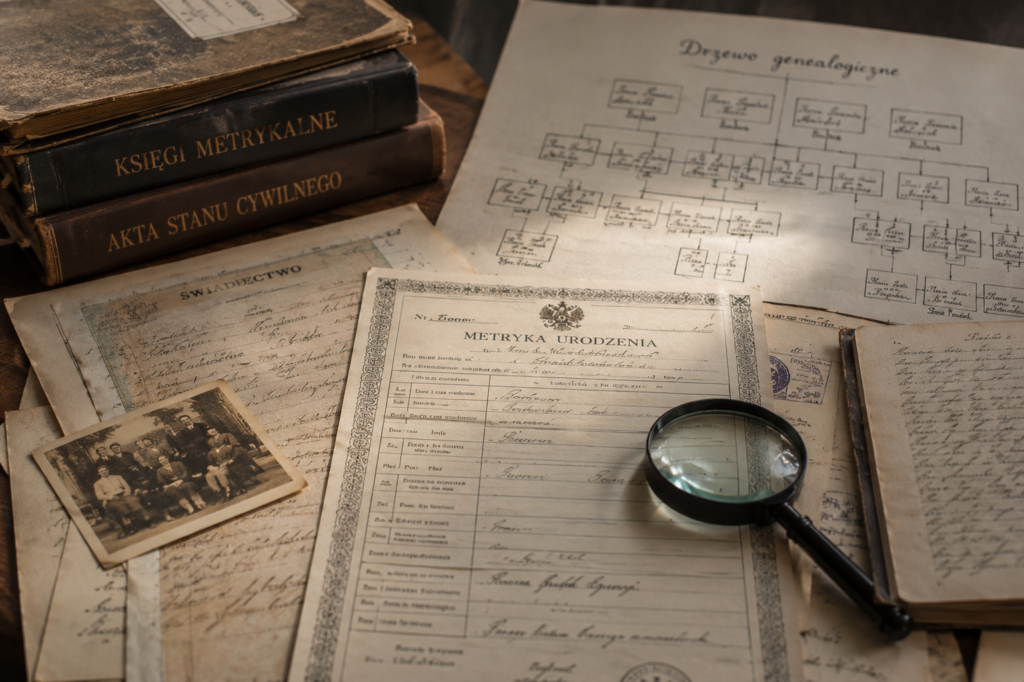
This kind of report doesn’t leave you in the dark and, importantly, often has value in its own right — especially when a search result (including a negative one) needs to be documented for an official procedure.
Why the Precision of the Request Matters
A targeted search is only as effective as the task is precisely defined. A vague request like “find something about my great-grandfather” turns into open-ended research of unknown scope — which is a different service altogether. A clearly formulated request (“birth record for Ivan Petrenko, presumably 1889–1891, such-and-such village, such-and-such county”), on the other hand, allows for a focused search with a predictable timeline and cost.
That’s why the first step — the brief — isn’t a formality but the foundation of the entire process that follows. If needed, at the brief stage I’ll help clarify and narrow the request when the starting data isn’t sufficient for a targeted search
How This Differs From a Full Genealogical Reconstruction
| Targeted Archival Search | Full Proof of Nationality | |
|---|---|---|
| Goal | Locate one specific document or fact | Build a complete chain of evidence across generations |
| Scope | A single episode, a single event | Multiple generations, numerous sources |
| Result | Document copy + explanation, or a report on non-findings | A complete package: documents, kinship diagram, source list |
| Best suited for | When you need a specific fact for a specific purpose | When the entire ancestral line needs to be proven (e.g., for citizenship) |
If it becomes clear during a targeted search that the task is actually broader — for example, the record found opens up the need to build a longer chain — I’ll say so directly, and we can discuss whether it makes sense to move to the full reconstruction format.
Who This Service Is For
- Those who are missing just one document for a specific official procedure
- Those conducting their own genealogical research who have hit a specific gap
- Those who want to confirm a specific fact of family history — military service, an award, a burial location
- Those who have already done part of the research and know exactly what’s missing